
On publishing William Blake’s Mysticism: The Legacy of Prophetic Women
By Dr Jodie Marley
William Blake’s reputation as a mystic has stuck to his art and to his character for centuries. To this day, I’ve visited Blake exhibitions and seen item labels describing his paintings’ mystic themes. My friends in esoteric circles are drawn to Blake’s works because, they believe, his works come from his visions, from his discussions with spiritual beings, from his communications with the divine.
Despite the cultural longevity of Blake’s mysticism, the subject and the word ‘mystic’ have not been popular in Blake studies for around 60 years. Nineteenth-century Blake critics used the word ‘mystic’ to refer to any number of elements of Blake’s work, from his engagement with Swedenborg to the appearance of his Visionary Heads. Over the decades, Blake scholarship defined and refined many of the influences within the wide mystic net: prophetic studies, the influence of Boehme, of Revelation and the Bible, to name but a few. Northrop Frye, in Fearful Symmetry, rightly criticised much of the old mystic scholarship as confusing, because its terms and boundaries were so vague.[1]
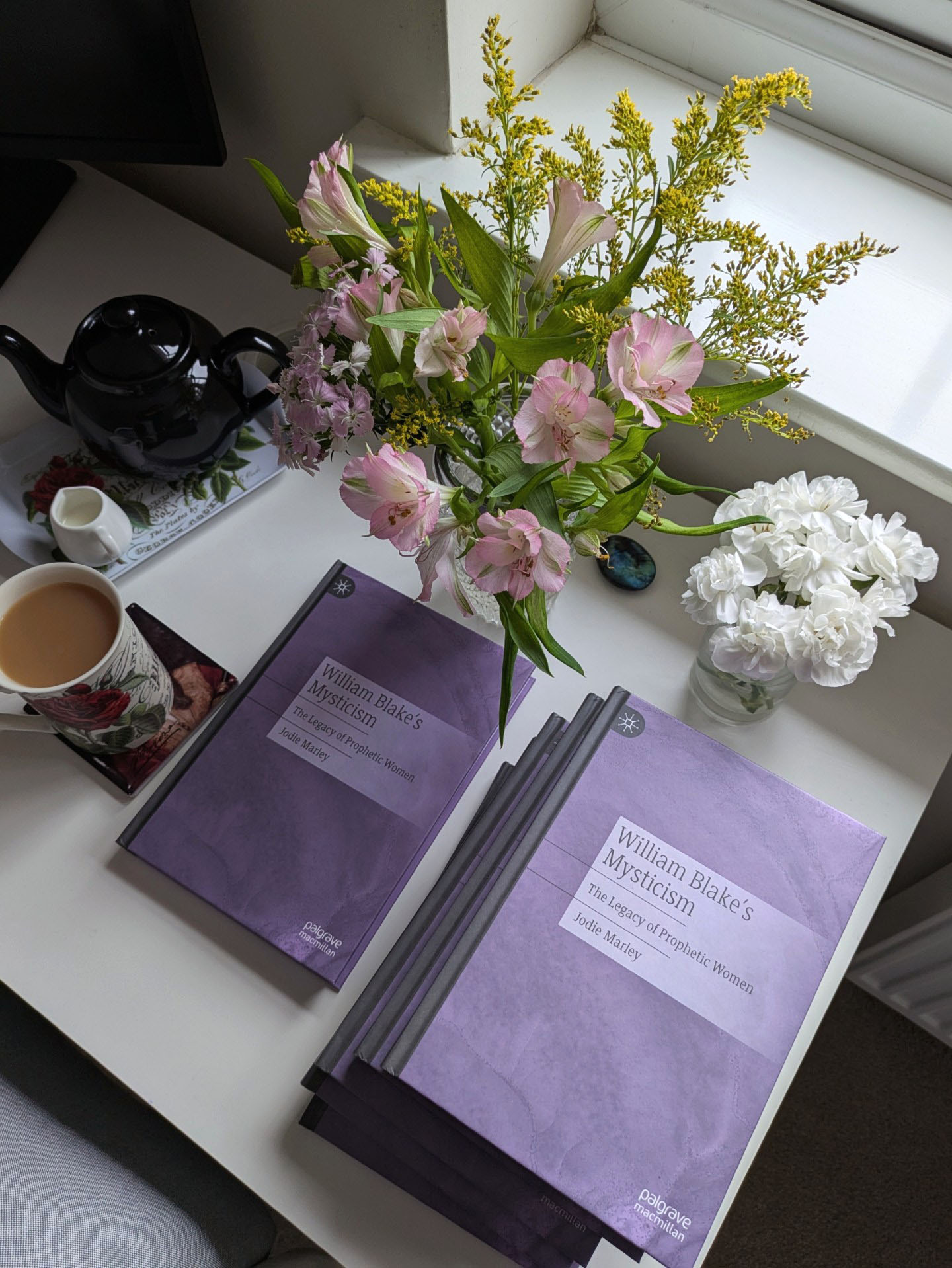
My new book, William Blake’s Mysticism, examines the work of Blake and his prophetic contemporaries to ascertain what exactly makes Blake’s work, and Blake himself, mystic. In the first half, I detail Blake’s overlooked female influences. In the second, I discuss the Celtic Twilight’s role in pinpointing and reviving Blake’s spiritual reputation, with a particular focus on the Yeats circle. For the first time in Blake studies, I consider Blake’s influence on the neglected Celtic authors George Russell ‘Æ’ and William Sharp/Fiona Macleod. Both authors have a unique approach to Blake, and study of them illuminates our understanding of how people responded to Blake in that era. The Sharp/Macleod chapter in particular focuses on Blake’s multi-bodied concept of gender, and the queerness inherent in his work; both of which are reflected in Sharp and Macleod’s writing.
This monograph will be valuable to those interested in many areas of research, including and beyond Blake. These include Romantic Studies, prophetic and millenarian studies, the literature and art of the eighteenth, nineteenth, and early twentieth centuries, the Celtic Twilight, Irish Modernism, and representations of queerness, the mystic, and the occult in the arts.
[1] Northrop Frye. 1974. Fearful Symmetry. Princeton: Princeton University Press. 415.
Biography
Dr Jodie Marley (she/her) is an early-career scholar and was recently a 2025 Visiting Research Fellow at the University of Glasgow. She publishes on Romantic receptions, national Romanticisms, the crossover of literature and visual arts, spiritual cultures, and gender and sexuality. Her monograph William Blake’s Mysticism was published by Palgrave in January 2026.
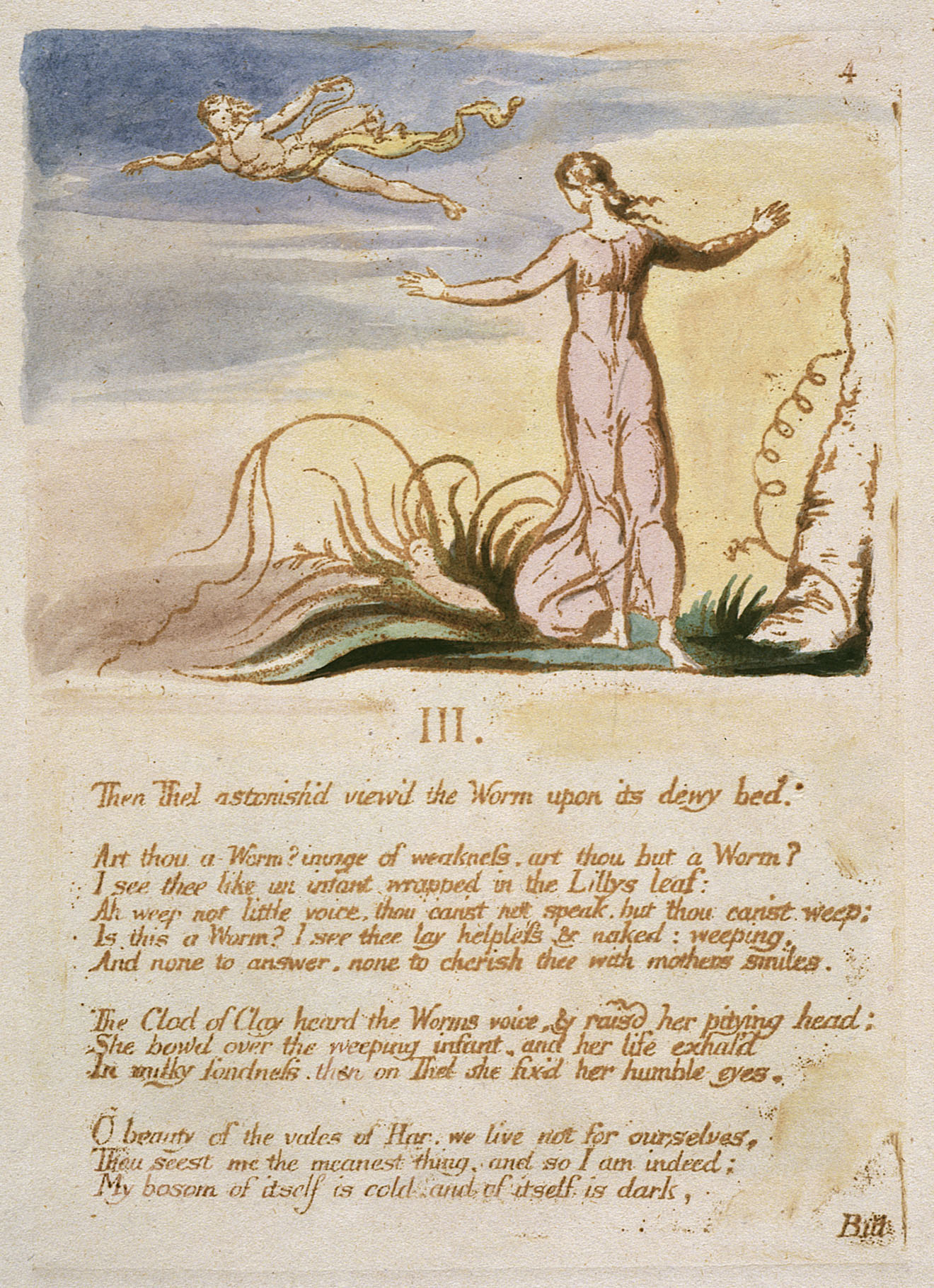
III. “Then Thel astonish’d view’d the Worm upon its dewy bed…”,
The Book of Thel, Copy B, Plate 6, (1789). Yale