
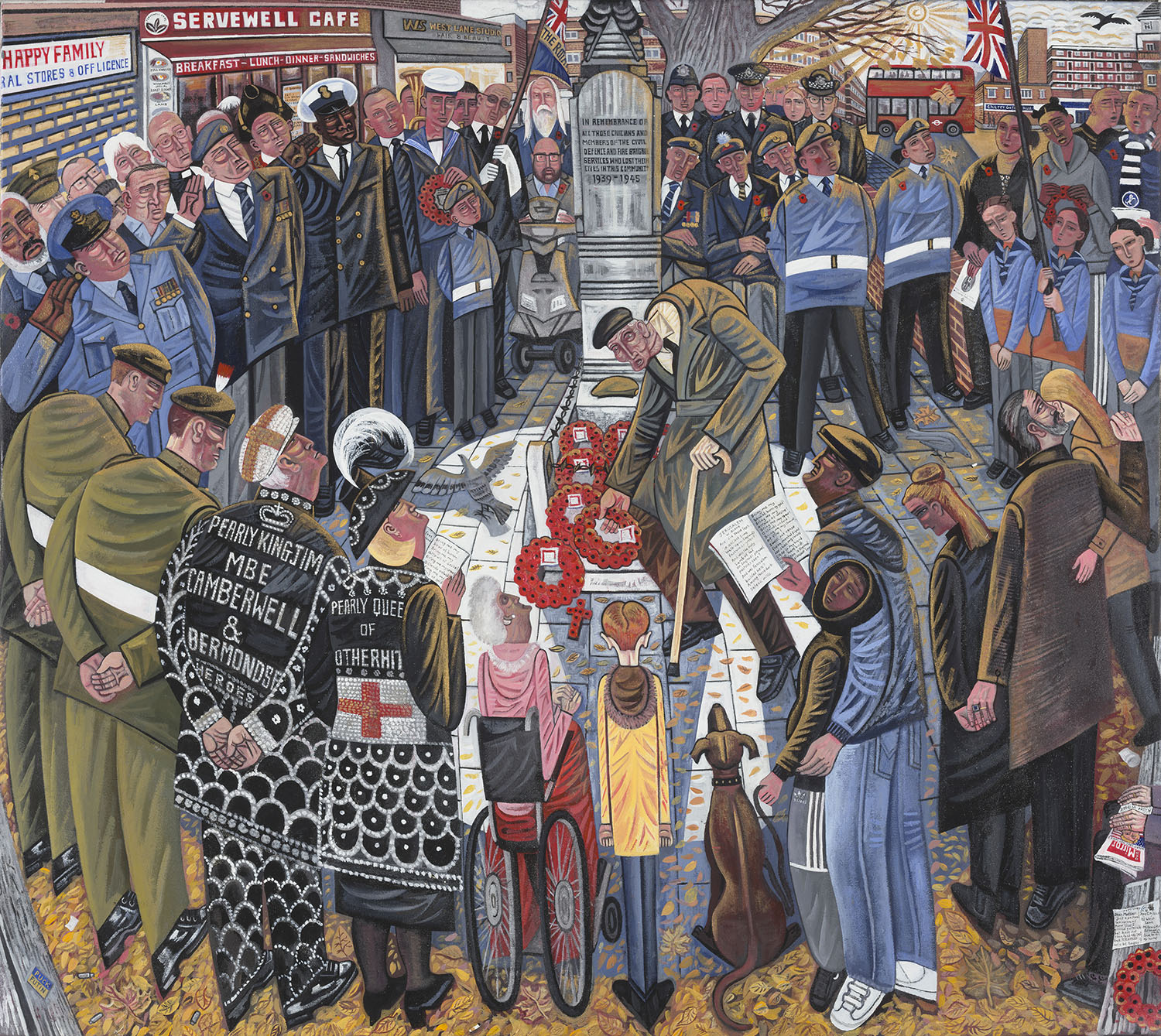
Remembrance, Rotherhithe War Memorial – In memory of Private George Mitchell of 21 West Lane 1888-1918
(Acrylic paint, chalk and charcoal on canvas, 145cm × 125cm) © Ed Gray
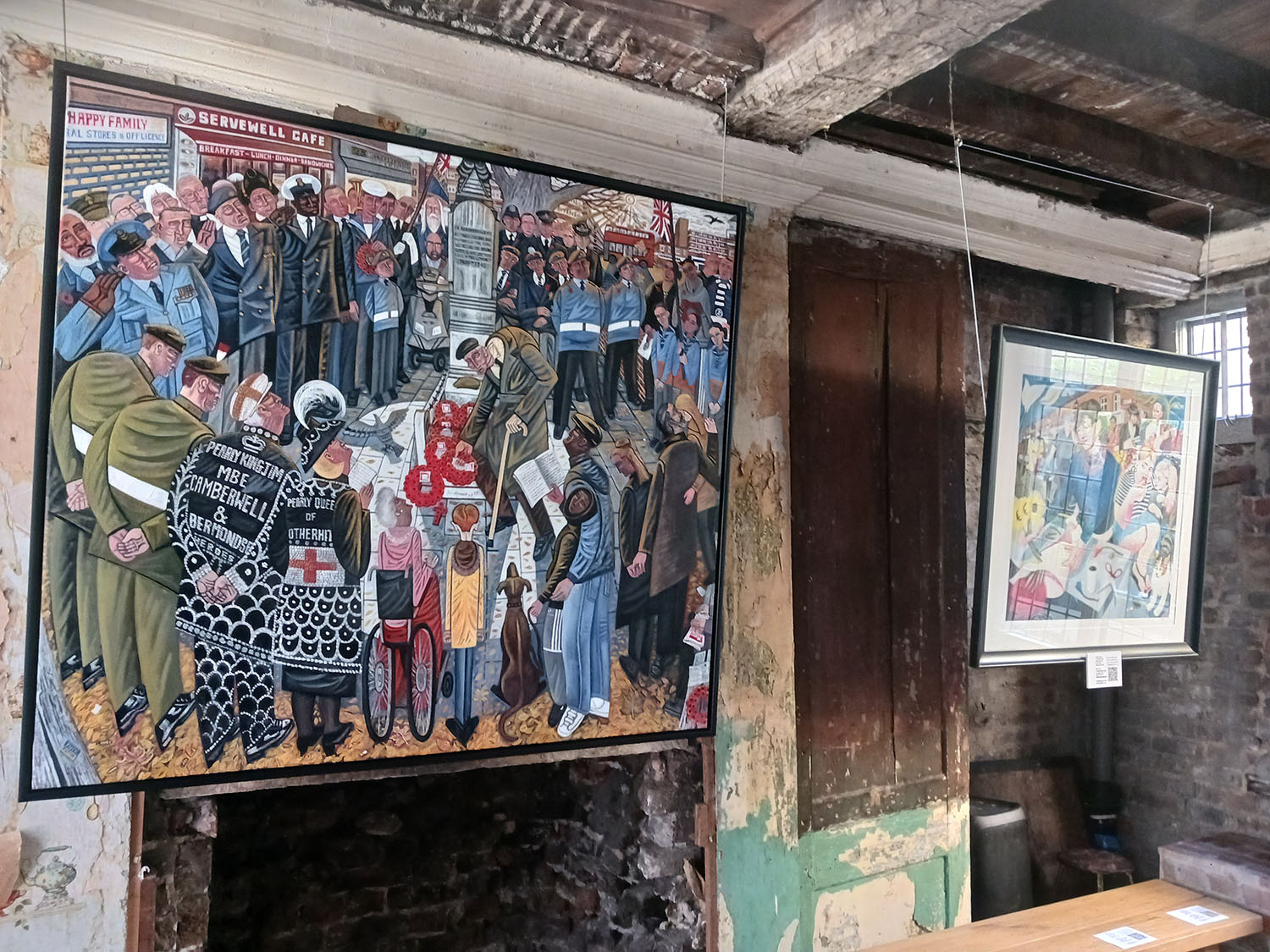
Remembrance
Mostly I paint city life. I go out sketching in London’s streets and head back to my studio to create large canvases, weaving my sketches together into ongoing graphic narratives that emerge over many months. For over 30 years, these paintings have documented my own life and my relationship to the city, the people and places I know, and the unknowable lives of countless others that I’ve poured into my sketchbooks before scraping, scratching and layering them onto canvases.
As an artist I’m inspired by the freedom and liberation I find in the work of William Blake. His words are on the wall as I work in the studio. Crooked roads, the business of creation, love, infinity, imagination as existence, the eternal dance, are all phrases that spin through my mind in the studio, connecting ideas and seeding themselves into my work.
Each one of my paintings goes through many versions, over many months. The studio floor fills up with discarded canvases scraped threadbare with sandpaper until some road taken leads to palace of discovery. Only then do I begin to understand why I was making that painting at that time.
Just as it was for Blake in the 18th Century, being an artist today is a political act, more than ever with the global resurgence of far-right politics, autocracies, fascism, ultra capitalism, man-made climate chaos and military industrialism.
My Remembrance painting is my response to children’s questions, at home and where I teach, about their refugee friends, fascism, conflict, industrial militarism, and communities that fight and suffer wars at local levels. I don’t know why I go to remember, but the strength of community bonds, ancestral worship and tribalism gives me a sense of hope. Endurance is a collective act. The communities we build are its foundation
This painting was difficult to make because of contemporary events in Ukraine, Gaza and Sudan, and because it is also about my own grandfather’s military service in 1914 and 1945, and that of another soldier – Private George Mitchell, a forgotten WW1 Private who lived at number 21 West Lane before the war memorial was built. George features in WW1 uniform on the left side of the painting, looking out at us.
Halfway through making the painting I discovered George’s story through the Commonwealth War Graves Commission website, A Street Near You. I learnt that Corporal George was demoted to the rank of Private after returning home to visit his dying father. He went AWOL when he overstayed his leave of absence to attend his father’s funeral. A friend located a postcard George had written to his mother telling her not to worry. George was killed in France a year later in October 1918, and, in a twist of fate, the war memorial was built outside his family home after the war ended.
I added gold paint to make the painting shimmer – a phenomenon that’s simultaneously present and absent, like George, who was declared as such by a military tribunal when he was demoted. Each Remembrance Day ‘Georges’, mostly young working class men, shimmer in our own lives as millions of forgotten remembered.
As much as it’s about George, this painting is also about women and children. The war memorial’s shadow is an arrow/missile, buried in the ground, and our son is its tip. Elderly female hands clutch George’s postcard. My wife watches our son. The crowd, people I see each year, sing of Blake’s ‘arrows of desire’. Arrow symbols fall through them, each brushed with gold, like armour. They are conjoined, like a wreath of poppies.
In the painting I am whispering to our daughter, searching for words of reassurance. There are no words because paintings are silent.
Ed Gray, Rotherhithe, October 2026