
Mike Westbrook, a master interpreter of Blake’s Songs
Mike Westbrook (OBE), patron of the Blake Society and one of the most distinguished figures in British jazz, died on April 11. His wide-ranging body of work leaves a legacy marked by experimentation and a long-standing dialogue with William Blake’s imaginative universe.
Born in High Wycombe, Buckinghamshire, in 1936, into a household that included a pianist and an amateur percussionist, Westbrook aspired from an early age to become an artist, and devoted himself to both music and the visual arts. While studying painting at Plymouth Art College, he found time to play music and formed his first jazz band. A job opportunity took him to London, where he resumed his studies and delved even deeper into music, juggling several bands, one of which became resident at the prestigious Ronnie Scott’s Jazz Club. The growing recognition of his musicianship and an encyclopaedic knowledge of jazz led him to work at BBC Radio 1 as a presenter and commentator, which he combined with a career in art education. The stage, however, was where he belonged, and after receiving a grant from the Arts Council, music became a full-time job and he embarked on increasingly ambitious projects.
The performing arts had always held a fascination for Westbrook, who, during his National Service, was exposed to the lingering reminiscences of pre-Weimar cabaret culture in Germany. His collaboration with the group Welfare State International on the experimental multimedia performance Earthrise (1969) drew him further into the world of theatre. This opened the way to a prolific collaboration with the poet and playwright Adrian Mitchell.
A prominent figure in Britain’s countercultural scene of the 1960s, Mitchell worked across a wide range of literary forms, from political manifestoes to poetry, journalism, novels, and drama. He took part in the groundbreaking International Poetry Incarnation at the Royal Albert Hall alongside American Beat poets, and described himself as a ‘socialist-anarchist-pacifist-Blakeist-revolutionary.’ One of the most devoted followers of Blake in swinging London, alongside poets Michael Horovitz and Pete Brown, Mitchell infused his work with references to his creative mentor, as exemplified by Lullaby for William Blake, included in the anthology Children of Albion (1969).
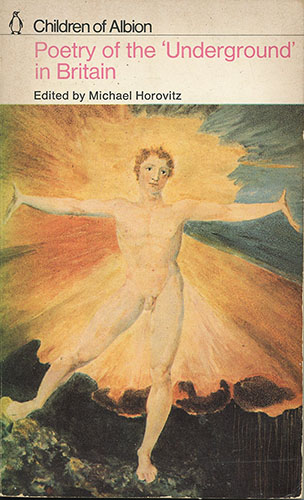
Children of Albion: Poetry of the Underground in Britain (Penguin, 1969)
That was a particularly intense Blakean period for Mitchell, who in the following year produced the 24-minute educational film On Reflection: Adrian Mitchell on William Blake, in which he shared Blake’s unconventional, anti-establishment nature and soon afterwards conceived the musical extravaganza Tyger, inspired by Blake’s life and work.
Westbrook, who shared Mitchell’s political views and avant-garde inclinations, was approached to collaborate in the theatrical production. His role consisted in composing music for both Mitchell’s text and Blake’s poetry and in performing the work live. Among the numbers incorporating Blake’s lyrics were ‘London Song’, ‘A Poison Tree’, ‘Let the Slave’ (excerpts from America a Prophecy and The Four Zoas), and ‘I See Thy Form’ (excepts from Jerusalem: The Emanation of the Giant Albion).
Tyger premiered at the National Theatre on 13 July 1971 and ran for six months, receiving popular acclaim while raising eyebrows of more conservative critics for its rather subversive approach. An album was released the same year, featuring an eight-piece band alongside several singers, many drawn from the cast.
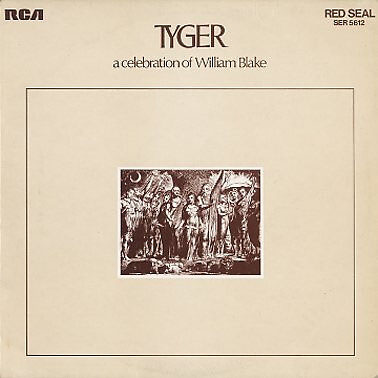
Tyger – A Celebration of William Blake (RCA Records, 1971)
Westbrook, whose knowledge of Blake extended little beyond the opening lines of Milton set to music by Hubert Parry when he was commissioned to write the music, was nevertheless deeply moved by Blake’s unwavering belief in his own genius. He admired his freedom of expression, self-determination and vision and shared, in particular, a strong commitment to social justice. Following Tyger, Blake became the basis of a long-term creative process and he continued to revisit his work, while also refining his musical interpretations.
In 1973, Westbrook formed the Brass Band with his wife, Kate, who became a crucial collaborator and interpreter of his music, mirroring William Blake’s own partnership with his lifelong companion, Catherine. The Brass Band also marked the beginning of a long artistic partnership with Phil Minton, whose powerful and dramatic vocal interpretations would remain a distinctive element of Westbrook’s Blake performances. Four of the songs he had composed for Tyger were included in the debut album For the Record (1975) in slightly revised form. Experiments in setting literary works to music initiated by his collaboration with Mitchell, were later expanded with The Brass Band. They often performed texts by nonconformist writers, including Brecht and Weill in political rallies, but as Westbrook later recalled, Blake held a central place: “the main rallying point was the William Blake song ‘Let the Slave’ (…) which became our anthem.”
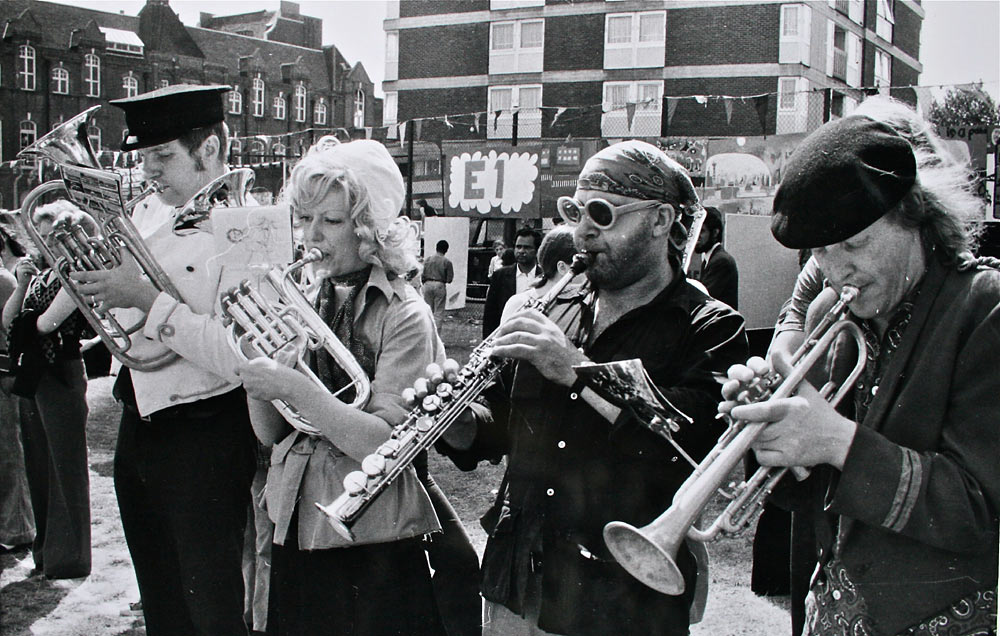
Mike and Kate Westbrook and their Brass Band
In 1977, Westbrook was again approached by Adrian Mitchell for another Blake project. Mitchell had been commissioned by Thames TV to produce a music drama to mark the 150th anniversary of Blake’s death. Titled Glad Day, it incorporated some of the material originally created for Tyger, including several songs. Westbrook was invited to prepare new arrangements and compose additional musical settings.
As with Tyger, Mitchell played a key role in selecting texts to be set to music, favouring those that emphasised Blake’s political and philosophical views. He proposed combining ‘The Tyger’ and ‘The Lamb’ into a single piece, as well as setting the poem ‘Long John Brown’, centred on a radical American abolitionist. Mike and Kate Westbrook, in turn, suggested ‘Holy Thursday’ (from Songs of Experience), a poem that attacks the hypocrisy of institutions such as the state and the church. Both old and new material were later brought together in the 1980 album The Westbrook Blake: Bright as Fire, devoted entirely to Blake’s poetry.
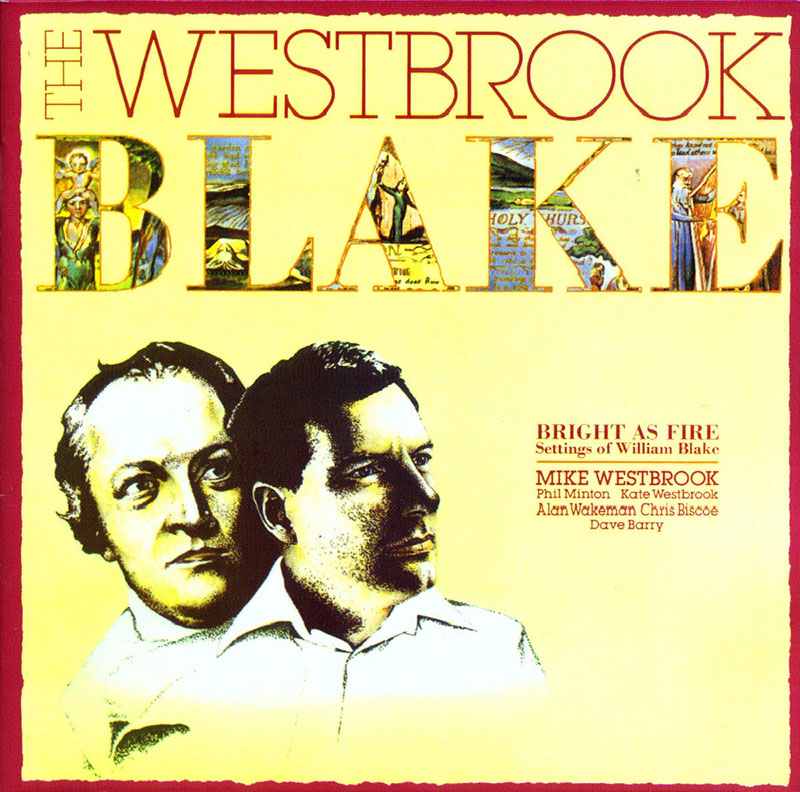
The Westbrook Blake – Bright as Fire (1980)
Westbrook’s engagement with social and political causes is explicit since the very early days of his career, as with the anti-war jazz symphony Marching Song (1969). It stands as an unquestionable proof that, through instrumental music alone, Westbrook was perfectly able to convey his ideas and intentions. After Blake, however, music and lyrics interwove as if they had always belonged together, emerging from the same mind and artistic genius. Blake’s poem ‘The Human Abstract’ speaks closely to Westbrook’s concerns about the future, particularly in the context of the threat of nuclear weapons during the Cold War. Inspired by the text Protest and Survive, written by E. P. Thompson, who drew a striking parallel between Blake’s ‘The Human Abstract’ and the anxieties of the Cold War, Westbrook set the poem to music. It was included in the soundtrack of the anti-nuclear film Half Life (1981) and Westbrook released it as a single in 1982 to raise funds for the Campaign for Nuclear Disarmament.
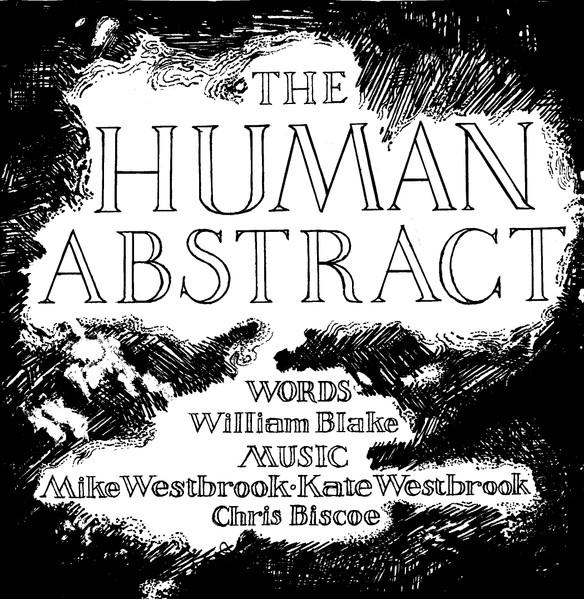
The Human Abstract (Original Records, 1982)
That year Westbrook released the album The Cortege, which contains an exquisite rendition of Parry’s Jerusalem. Unfortunately, this version was only rarely played live and never made it on to the Blake albums he produced over the years.
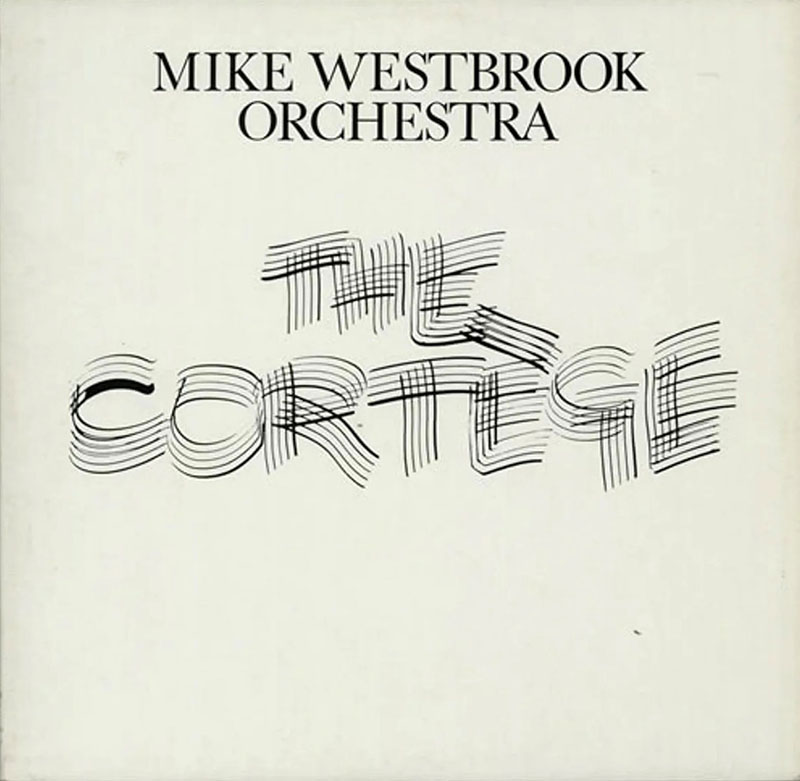
The Cortege (Original Records, 1982)
After over 15 years sleeping, The Westbrook Blake was revived in 1996 at the Greenwich Festival, where the original Brass Band was reassembled specifically for the occasion. The programme was also expanded to incorporate additional texts by Blake, marking the first live performance to feature a choir.
The revival inspired the release of the double album Glad Day in 1997. It incorporates the songs composed for the Thames TV music drama, the single ‘The Human Abstract’ and introduces two new settings, ‘Lullaby’ and ‘Glad Day.’ While ‘Lullaby’ has its lyrics drawn from the poem ‘Cradle Song’ from (Songs of Innocence) ‘Glad Day’ is an instrumental piece inspired by one of Blake’s most famous illustrations, the same that appears on the cover of the poetry collection Children of Albion. The award-winning album presents Mike Westbrook’s Blake settings in their most realised form, with the successful integration of a choir, which added even more poignancy to Westbrook’s settings and was preserved in most of the performances in the years that followed.
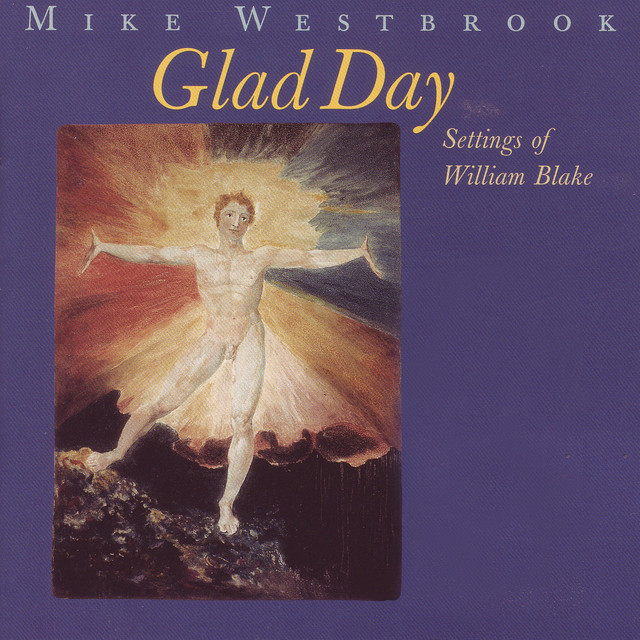
Glad Day (Enja Records, 1999)
Hugely acclaimed for his Blake repertoire, Westbrook set out to capture the lively and dynamic experience of the staged performance, preserving at once its musical and theatrical immediacy. Recorded at Toynbee Hall in 2008, Glad Day Live features Mike, his band and the London College of Music Chamber Choir, conducted by Paul Ayres. It was released in CD and DVD formats in 2014.
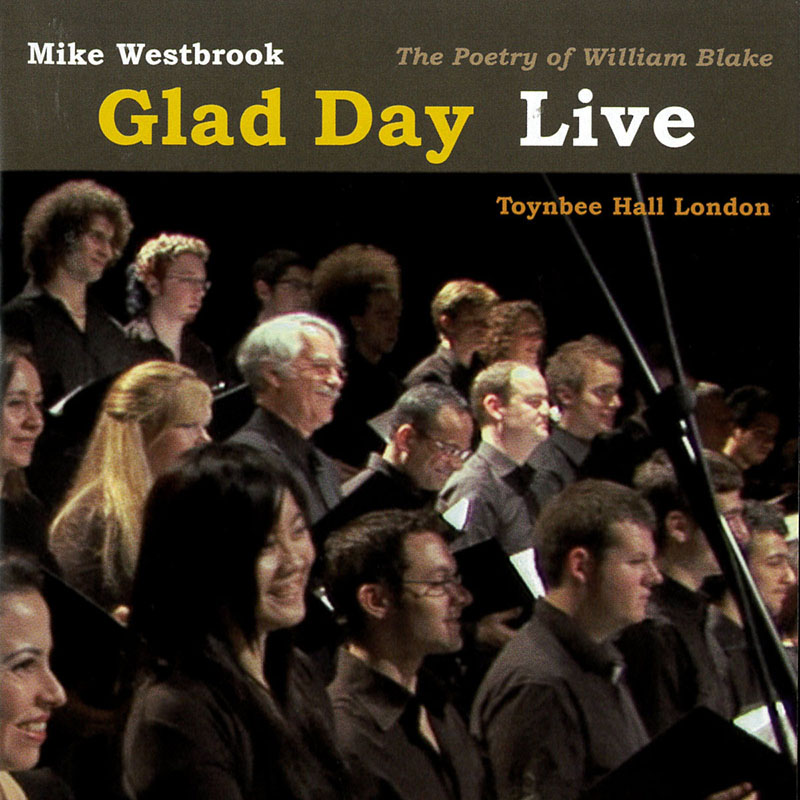
Glad Day Live (Westbrook Records, 2014)
Westbrook’s close relationship with Blake endured into the very twilight of his life. He spread Blake’s words far and wide, introducing him to international audiences, often incorporating translations of his poetry into concert programmes so listeners could better understand and appreciate what they were hearing. His insatiable curiosity often led him to return to the same material over the years, across different contexts, each time exploring new facets of the text and developing new musical inflections. This continuous reworking mirrors Blake’s own compositional practice, reinforcing the idea of the artwork as a unique outcome of a specific moment and context, and rich in its distinctive qualities — or what Blake called ‘minute particulars’ — at each new performance and in each new arrangement.
It is painfully moving to realise that the last time Westbrook stepped onto the stage was to perform his Blake songs at Blackheath Halls on 20 December 2025, on the brink of his 90th birthday. Equally touching was his participation along with his wife Kate in the Blake Society Annual Meeting in January 2026, when he gladly accepted the proposal to compose music for the bicentennial of Blake’s death.
What might that song have sounded like? We are left to wonder and to reimagine it, just as we continue to do with the songs Blake himself once sang.
Rest in power, Mike
Camila Oliveira Querino
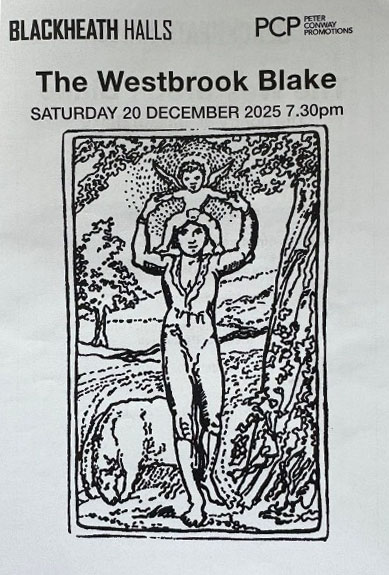
Programme from Mike Westbrook’s last performance, Blackheath, London (2025)
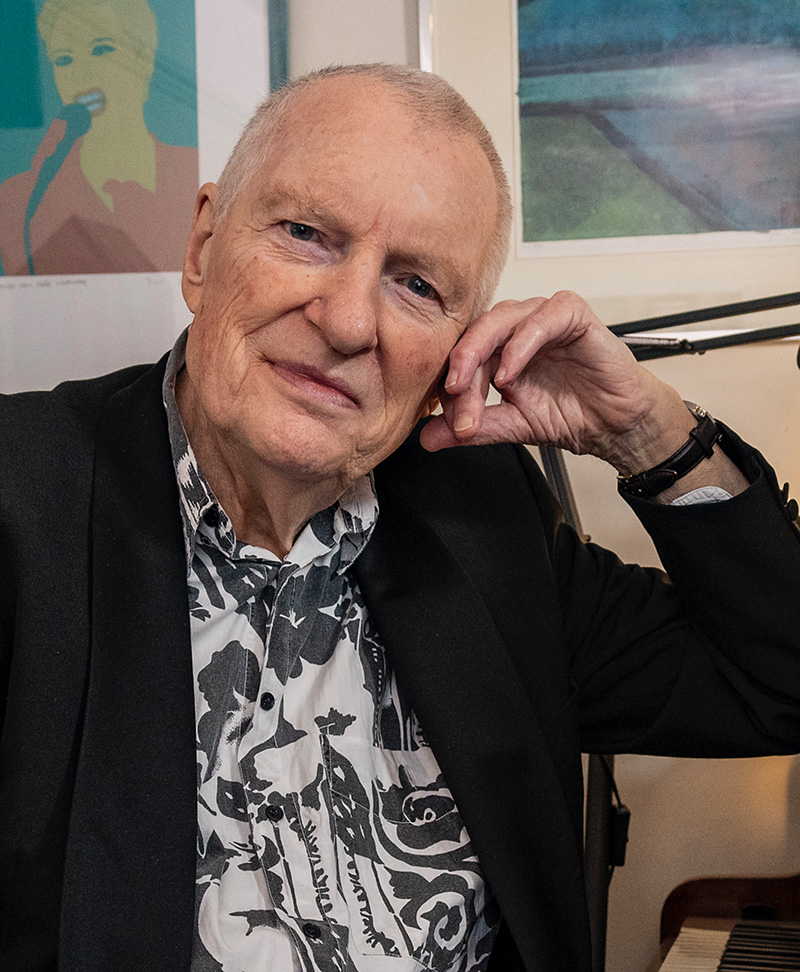
Mike Westbrook (photo by Tim Dickeson)